If you are looking for a top notch real estate agents look no further! The agents in our office think outside of the BOX and focus on you and YOUR needs. We offer what most of the other agencies in the area cannot. Creativity, Listing Package Options, unsurpassed marketing exposure with exceptional service. Expertise in luxury lake homes,lake homes,luxury homes, residential single family,condos, vacant land,foreclosures, investment and commercial properties. Serving all of WISCONSIN
If you're thinking about selling your home in 2015, here are some resolutions that could help boost your chances of a quick sale.
Repeat to yourself: "I pledge to…"
1. "Avoid drastic design changes" – Unless you plan to
turn your bold color palette into a more neutral one, then it's best
not to try and anticipate what buyers want in design and décor. The best
approach to freshening up your home for sale is to simplify and
depersonalize the look and feel so that potential buyers can picture
building their own lives there. If you think repainting a bright purple
wall, replacing an old toilet or buffing and restaining kitchen cabinets
would help the home sell, by all means make these types of updates.
Just be sure to keep your personal preferences in check. Your real
estate agent can help you prioritize and remain objective.
2. "Stop neglecting the drippy faucet" – This applies
to any repairs you might view as minor but actually could be a symptom
of a larger system problem. Addressing things like plumbing leaks, poor
ventilation and cracks in walls helps everyone avoid surprises from the
inspection report and avoid the delay or even cancellation of a sale.
When you have the information, you can either make the fixes or work
with your agent to adjust pricing during negotiations with the buyer.
3."Price my home reasonably" – It's
understandable to think your home is the best on the block and worth
more than all the others – especially if you've invested in key upgrades
and remodels. And, frankly, you might be right. But the only way to
truly know is to consider recent sales of comparable homes in your area.
Your real estate agent can provide you with the latest information and
help you list at a competitive price that's appropriate for your area
and the local real estate climate.
4. "Make my home inviting" – This starts with creating
curb appeal. The condition of your home's exterior is a big part of
getting buyers in the door. Maintaining the yard, sweeping the porch and
driveway, replacing the tattered welcome mat, replacing missing house
numbers, and removing clutter all are things that can help improve curb
appeal.
5. "Thin out the clutter" – The best time for making
tough decisions about what stays and what goes is BEFORE you put your
home on the market. By the time the for-sale sign goes up, the home
should be clutter free. You can either toss things you don't want, sell
these items, or move the more personal ones to storage. The types of
items to remove include your prized knick-knack collection, clothes
overflowing from the closets, and family photos. You want all closets
and cupboards to appear as spacious as possible. When they're
jam-packed, it gives the impression that storage is limited even if
that's not the case.
6. "Clean like I've never cleaned before" – Think
about under, behind, around and between. It's easy to focus on cleaning
the major surfaces, high-traffic areas, and areas that are visible. But
what about the dust on top of the refrigerator? How about the slats in
the window blinds? Have you cleaned the cabinets under the kitchen or
bathroom sink recently? Did you notice the cobwebs behind the guest-room
door? Look high and low for the dirt.
7. "Nail down my next step" – Don't let your new plans
and new place get lost in the shuffle of selling your old place.
Determine where you'll go next before your home goes up for sale. Are
you prepared to move if your home sells quickly? Although it might not
be typical, a quick sale is certainly possible. On the other hand, are
you prepared if your home doesn't sell quite so quickly? Be sure to talk
with your real estate agent about your relocation needs and timeline.
Find a local RE/MAX agent who can tell you all about his or her own resolutions for helping you meet your real estate goals.
Today we are pleased to have Nikki
Buckelew back as our guest blogger. Nikki is considered a leading
authority on seniors real estate and housing. Enjoy! - The KCM Crew
It was her 80th birthday and as Sue's family gathered around in
celebration, she announced a major decision. After years of toying with
the idea, she had come to the conclusion that now - yes, now - was the
proper time for her to move into a continuing care retirement community
(CCRC).
Although they were a bit surprised, Sue's two adult children (both
seniors themselves) nodded to each other and expressed relief that their
mother would have access to the support and care she needed. Both
admitted to a bit of worry about her living alone since their dad died,
especially as they both traveled extensively and were not available to
see her or care for her on a regular basis.
But, of course, they all realized that such a move would require a
massive commitment of time and energy, with the first necessary step
being to find a good real estate agent to help sell the longtime family
home.
Sue mentioned that she was acquainted with an agent she had met at
church and who regularly sent her mailings. The agent seemed quite nice
and professional, had won numerous awards, was active in the community,
and owned a variety of impressive-looking credentials. You know, she had
a whole bunch of letters and acronyms at the end of her name.
Sue and her children arranged for a meeting with the agent, and while
she was clearly competent and well-educated in her field, Sue just
couldn't get past a nagging feeling that something was amiss. The agent
was nice enough, but throughout Sue's entire life, she had tended to
gravitate toward doing business only with those to whom she felt some
sort of connection. Perhaps it was something she had learned from her
father, a man who valued relationships in business dealings as much or
more than mere competence. Not only did she want help, but she also
wanted to feel a special sort of bond and trust.
The practice had served her well throughout life and now - with such
an important transaction - she wasn't about to change her approach.
Sue scanned the yellow pages, spoke on the phone with a few agents,
and even met with another over coffee, but still she couldn't find the
sensation of trust and comfort she desired. She even did a couple of
quick internet searches leaving her feeling confused and frustrated. It
occurred to Sue's daughter that perhaps the CCRC that was to be Sue's
new home would be able to provide a recommendation for a good agent.
Indeed, they did, and that's when she met Joe.
Joe was different
He arrived at her home and immediately the two hit it off. Sue hired
Joe to list and sell her house and as he began to take his leave, Sue
touched him gently on the arm and said "Thank you, Joe. You are
different than other agents I've met with," she smiled. "I don't know
exactly what it is, but I feel I can truly trust you to help me make
this move."
Sue's home sold quickly, and with Joe's help, she arranged for an
estate liquidator to sell the belongings she no longer needed. He also
arranged for a moving company to pack and transport what was needed to
Sue's new apartment at the retirement community, and made sure she was
content in her new home.
A few days later, Sue's children visited their mother, breathed a
sigh of relief that everything seemed under control, that a large
project was complete and that - most importantly - Mom was happy,
healthy, and safe. Her daughter (who admittedly had been a bit annoyed
at Sue's "pickiness" in choosing an agent) smiled and remarked that Sue
had made a fine decision in choosing Joe to spearhead the sale and move.
"But Mom," Sue's son asked. "How did you make your decision? Why did
you choose him?"
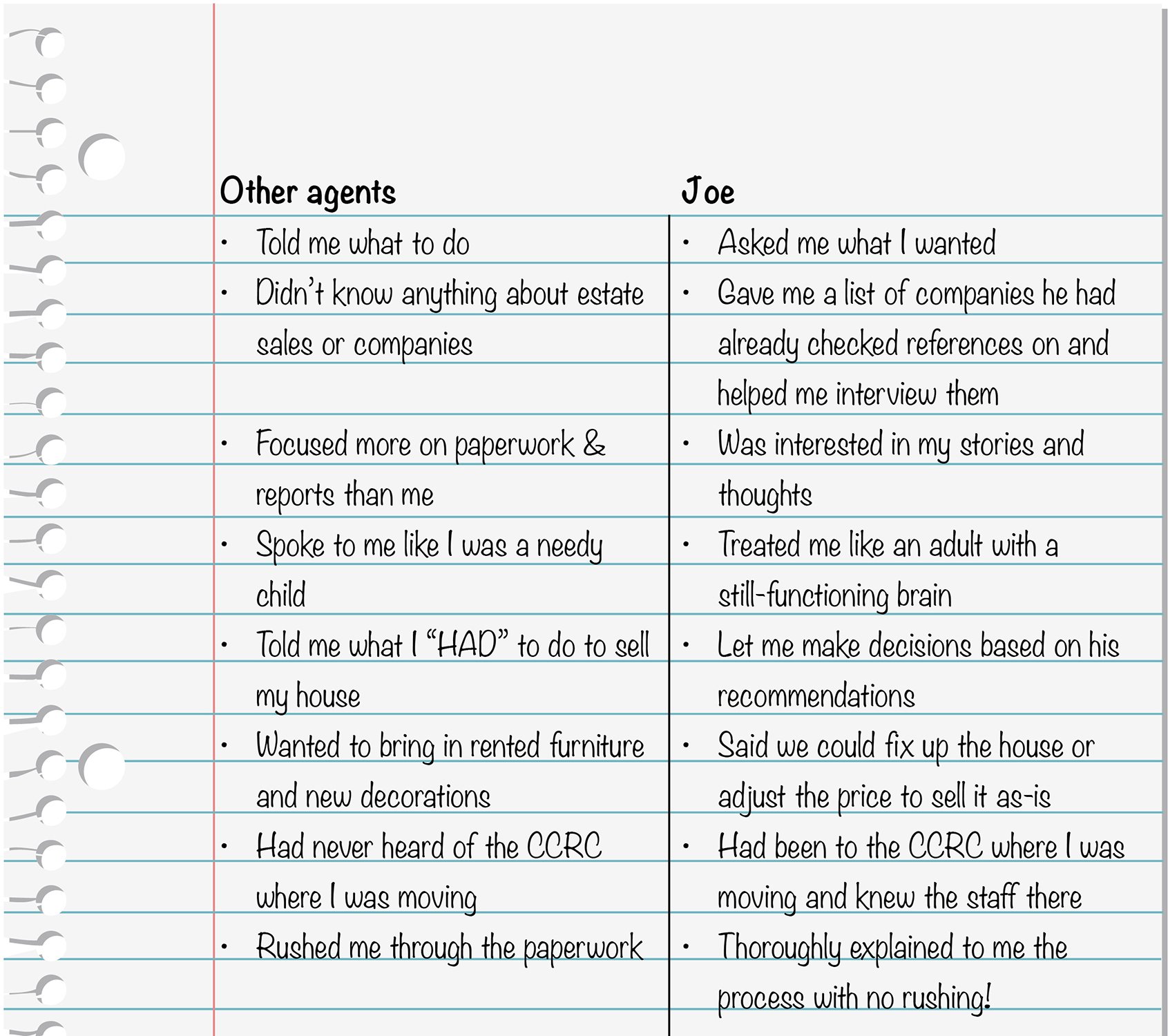
Sue dug into her purse and drew out the list of notes she had made while interviewing Joe:
As her daughters looked at the list, Sue remarked "I felt 'OK' with
the other agents. They were undoubtedly good at their jobs. But I wanted
someone who was good for ME too."
And thus ends the happy story of Sue, a senior whose outlook on doing
business mirrors that of most of her generation, nearly all of whom
value a firm handshake and "good vibes" as much as they do hard numbers
and competency.
Bottom Line
As real estate professionals serving seniors, it's important that we
understand that what makes for a great partnership, truly is in the eyes
of our clients.