Showing posts with label Investment property. Show all posts

Tuesday, April 11, 2017

FLIPPING A PROPERTIES - What you NEED to know!


The Department of Housing and Urban Development (HUD) issued new rules for FHA loans and house flipping

The full text of the new guidelines can be found in the new Single Family Housing Policy Handbook,  (page 145-146) which defines flipping as buying and selling a home at a significant profit in a short amount of time. In a nutshell, the rule states that buyers who wish to purchase a flipped property can't do so until 90 days have passed between when the seller purchased the property and when they are reselling. 

Guidelines for Property Flipping With an FHA Loan

Let’s start with a definition. In the new handbook, HUD defines house flipping as “the purchase and subsequent resale of a property in a short period of time.”
Time Restriction on Title Transfer: 90-Day Rule
In order for a home to be eligible for FHA financing, a certain amount of time must pass between (A) the date on which the seller acquired the title and (B) the sales contract execution date that will result in the FHA-backed mortgage loan. In other words, they will look at the length of time the investor or flipper holds the title, before transferring it to a buyer using an FHA loan.
In this context, the initial date of acquisition is when the investor or flipper acquired legal ownership of that home. That’s the first important date. The second important date occurs when the sales contract is signed and executed by “all parties intending to finance the property with an FHA-insured mortgage.”
The time between these two dates will determine whether or not an FHA loan can be used to purchase the flipped property. And this is where the all-important 90-day rule comes into play.
Generally speaking, a home that is resold 90 days or less after the first date of acquisition is not eligible for FHA mortgage financing.

Second Home Appraisal Required in Some Cases

In some flipping or quick-turnover scenarios, HUD will require a second appraisal on the home. Here again, the length of time between purchase and resale determines the course.
If the resale of a home occurs somewhere between 91 and 180 days after the seller acquired the property (and the resale price is 100% or more above the initial price paid), the lender must obtain a second home appraisal to determine the current market value.
According to the 12/30/16 recised handbook, if the second home appraisal shows a value that’s more than 5% higher than the first appraisal, the lesser of the two values will be used for FHA loan purposes.

Special Circumstances: Exceptions to the ‘No-Flip’ Rule

As with most FHA loan guidelines, there are a few exceptions to these flipping rules. For instance, the time restrictions mentioned above may not apply when:
  • The home is being purchased by an employer or relocation agency to relocate an employee.
  • The home is being resold by HUD, as part of its REO program for selling foreclosures.
  • The home is being sold by a government agency, a HUD-approved nonprofit agency, a state or federally-chartered financial institution, or a Government-Sponsored Enterprises (GSE) like Fannie Mae.
  • The home being sold was acquired through an inheritance.
  • The property falls within a Presidentially Declared Major Disaster Areas (PDMDA), and has been issued a notice of exception from HUD.
The exceptions listed above aren’t true house-flipping scenarios. They are unique circumstances. That means the 90-day rule for FHA purchases applies to nearly all home flipping situations.
The more troubling and longstanding rule effecting the warrantability of flipped properties comes from Fannie May's regulation of conventional loans. This rule focuses on the seller's profit: if it's more than 20% from sale price to sale price, the 90 day rule is enacted here too. 

CONVENTIONAL LOAN 90 DAY DEED RESTRICTION

Here what is important is the deed's recording date--as in when the investor's deed was recorded. This date marks the start of the 90 day count. Within the 90 days, the property can be sold for anything less than 120% of the investor's purchase price, and has nothing to do with repairs or improvements. On day 91 and on, the property can be sold for any amount. 

FHA'S 90 DAY FLIP RESTRICTION


The same timing applies here: the 90 day clock starts with the transfer of title/deed record date when they initially purchased the property. From the transfer of title, 90 days must pass in order for a buyer to obtain an FHA loan. 

What does all of this mean? Short of finding the illusive cash buyer, investors will be waiting at least 90 days plus ~30 to 45 days for loans. My advice is to list the property when it's ready, and enter into an agreement with a buyer to execute a contract on day 91. This is really the only way to make the math amount to the 91 + 30 to 45, instead of potentially a whole lot more. 

Tuesday, March 29, 2016

NEW LISTING! INVESTOR ALERT!

NEW LISTING! INVESTOR ALERT! 

270 N. Monroe St.-Waterloo, WI 53594

Have you been thinking about purchasing a duplex? Make your appointment today! Now is a great time to invest, contact me and find out how to purchase a NON Owner Occupied investment property with 10% down! This is great program, start investing today! #investing #wirealestate #investor


http://www.ambershomefinder.com/property/wi/53594/waterloo/-/270-n-monroe-st/56f2acfd1c740b55b0000d0d/


Amber Castonguay

Direct: 920-988-0048
Text: 920-988-0048
Fax: 866-211-2826

RE/MAX Realty Center
357 W Wisconsin Ave
Oconomowoc, WI 53066
Office: 262-567-2455

Connect With Me

Find Me on Facebook Connect with me on LinkedIn Follow me on Twitter Follow me on Google+ Active Rain Follow me on Pinterest Follow me on Trulia

Wednesday, February 10, 2016

Increasing Interest Rates and Real Estate Investing

Posted: 08 Feb 2016 07:35 AM PST

In December, the Federal Reserve announced that it will be raising the short-term interest rate for the first time in almost a decade. It has held that interest rate at near zero as a method of stimulating the economy. The initial increase will be mild at an announced rate increase of between 0.25 and 0.5 percent. However, the announcement also indicated that more rate increases are coming if the US economy continues its slow growth or accelerates. However, the world economy remains constrained and that will influence US financial policy as well.

Increasing interest rates will certainly affect the real estate investment business. If you are borrowing money as a mortgage to become a landlord, your business costs will increase but rents are also likely to increase. If you are borrowing money to rehab and flip houses, your cost of interest will increase but it is still a seller’s market with selling prices on the increase.


money-33185_1280

Lending Money Is Where the Money Is At

As always, there is risk when it comes to any kind of investing, including real estate investing. One way of minimizing that risk while increasing earnings is by becoming the lender as interest rates rise. A great sources of funds for this are IRAs, 401ks, and other retirement accounts. The secondary lending market (alternative to bank loans) has become much stronger over the past seven or eight years.

While the federal interest rate remains extremely low and bank mortgages are around four percent, private lenders are earning between eight and twelve percent. Of course, with that comes a higher degree of risk. Earning the higher interest rate means lending to higher risk borrowers. However, investing retirement funds in a first mortgage provides a high level of security when it is secured by the house or other property. Security can be further increased by loaning no more than 70 percent of the property value and requiring the property buyer to invest the other 30 percent. Of course, the lower your risk, the lower interest rate you’ll be able to charge.

Alternative Retirement Investing

Investing retirement funds is not limited to Wall Street stocks, bonds, and mutual funds. There are many alternatives. One is a self-directed IRA that can be administered by a third party such as PENSCO (there are other self-directed IRA administrators). These types of accounts allow you to invest your retirement funds in alternative investments such as real estate. You can either directly purchase the real estate or loan money secured by real estate. You can also buy stocks in private companies and have many other investment opportunities.

There are very specific rules that you must follow when making alternative investments. One of the most important is that you can’t invest in a company that you personally own or operate nor businesses owned and operated by direct family members. That’s where a self-directed IRA administer comes in. You can place your retirement funds in a trust with the administrator and direct them how you want your money invested. Unlike a financial adviser, they won’t give you investment advice. You have to specifically tell them where you want to invest. Just like a traditional IRA, you don’t financially benefit until you reach retirement age. But upon retirement, you can sell your assets and begin drawing your retirement pay.

Please leave a comment if this article was helpful or if you have a question.
Photo
Author bio: Brian Kline has been investing in real estate for more than 35 years and writing about real estate investing for seven years

Tuesday, January 26, 2016

Can you become a FLIPPER?

What's the Deal with Flipped Homes?

Americans love their home improvement and design shows. With entire channels dedicated to DIY, home decor and design, and everything related to U.S. real estate, we love the possibilities that lie within the real estate market in America. One popular aspect of many shows and publications is home or house flipping. We hear a lot about flipping homes, but what does that really mean? Is it feasible for everyone? Are there risks? Should you buy a flipped home, and what questions should you ask if your property search lands on a potentially flipped property?
What is Flipping?
Flipping is a predominately U.S. term used to describe purchasing a property with the intent of quickly reselling it for profit. Most of the time, properties that are purchased with the intent to flip are those that are distressed, abandoned, or otherwise in need of repairs that make the property less desirable to other potential buyers. Flipping has become increasingly popular throughout the U.S. in the last decade, and many people have become successful real estate flippers with the vast and varied real estate markets throughout the United States.
 Can Anyone Flip a Property?
Many programs on television make house flipping look easily attainable to anyone and everyone. The fact remains that flipping a property is risky business that requires a large amount of work, experience, funding (preferably cash), excellent credit and a good understanding and almost intuitive knowledge of the real estate market. If you're interested in flipping properties, the best way to get started is by talking to someone who has experience and has had success in flipping real estate. There are many things to know about flipping real estate that should be addressed before the idea is even entertained.
What are the Risks of Flipping a Home?
There are risks with any kind of real estate investment, but inexperienced flippers can make a number of mistakes. There are a number of costs that come with flipping a property, and new flippers can make the mistake of not having enough money to cover the entire project – from the acquisition of the property, to the renovations, taxes, utilities and more. Another risk of flipping properties is time, or lack of time. Finding the right property can take months, and once you own the property there is a time commitment to renovations, commuting, inspections, and ultimately the marketing and selling of the property.
 Other risks that new flippers run into are not having enough knowledge about the real estate market and failing to purchase the right property for a flip; a lack of skills when it comes to working on the property and putting in the sweat equity (hard work) required to get it up to market standards; and ultimately lacking patience when it comes to the entire project as a whole.
 Should I Buy a Flipped Home?
Often, flipped homes have mostly cosmetic changes done in order to attract buyers and ultimately get the property sold. You might fall in love with fresh paint and brand new appliances, and generally speaking, most flipped homes attract many buyers because they have a smaller initial to-do list than other properties on the market. If you're looking at a property that could be a flip, be sure to ask these questions: What is the home's sale history? If the home recently sold for much less than its current asking price, it's possible it is a flip. Does the outside of the home match what's inside? If the exterior of the home is older, and the interior looks brand new, it's very possible someone is trying to flip the property. Information is your best friend when it comes to a flipped home, so getting the most information up front will help guide you toward pursuing the property or not.
 If you believe you're looking at a flipped home, consider asking the seller what changes have been made to the property, and check to see if any permits were issued for the work. Also, some buyers might be blinded by all the new interior cosmetic updates that they forget about the bones and foundation of the home. Regardless of whether a home is old or new, always hire an experienced and licensed inspector to check over the home to make sure you're getting the most for your money when it comes to buying a property.
Contact me if you are interested in becoming a FLIPPER!  Lisa Bear 262-893-5555 or lisabear@remax.net

Thursday, January 7, 2016

Paying rent does not make sense...

Real Estate Shines as an Investment in 2015

Real Estate Shines as an Investment in 2015 | Keeping Current Matters
A survey by The Joint Center of Housing Studies at Harvard University reveals that when a family is buying a home they consider the financial benefits of homeownership along with the social benefits. The survey mentions things like:
  • Paying rent does not make sense
  • Homeownership provides a good financial opportunity
  • Owning a home helps you building family wealth
  • Buying a home is investing in your retirement
  • Home equity gives you something to borrow against
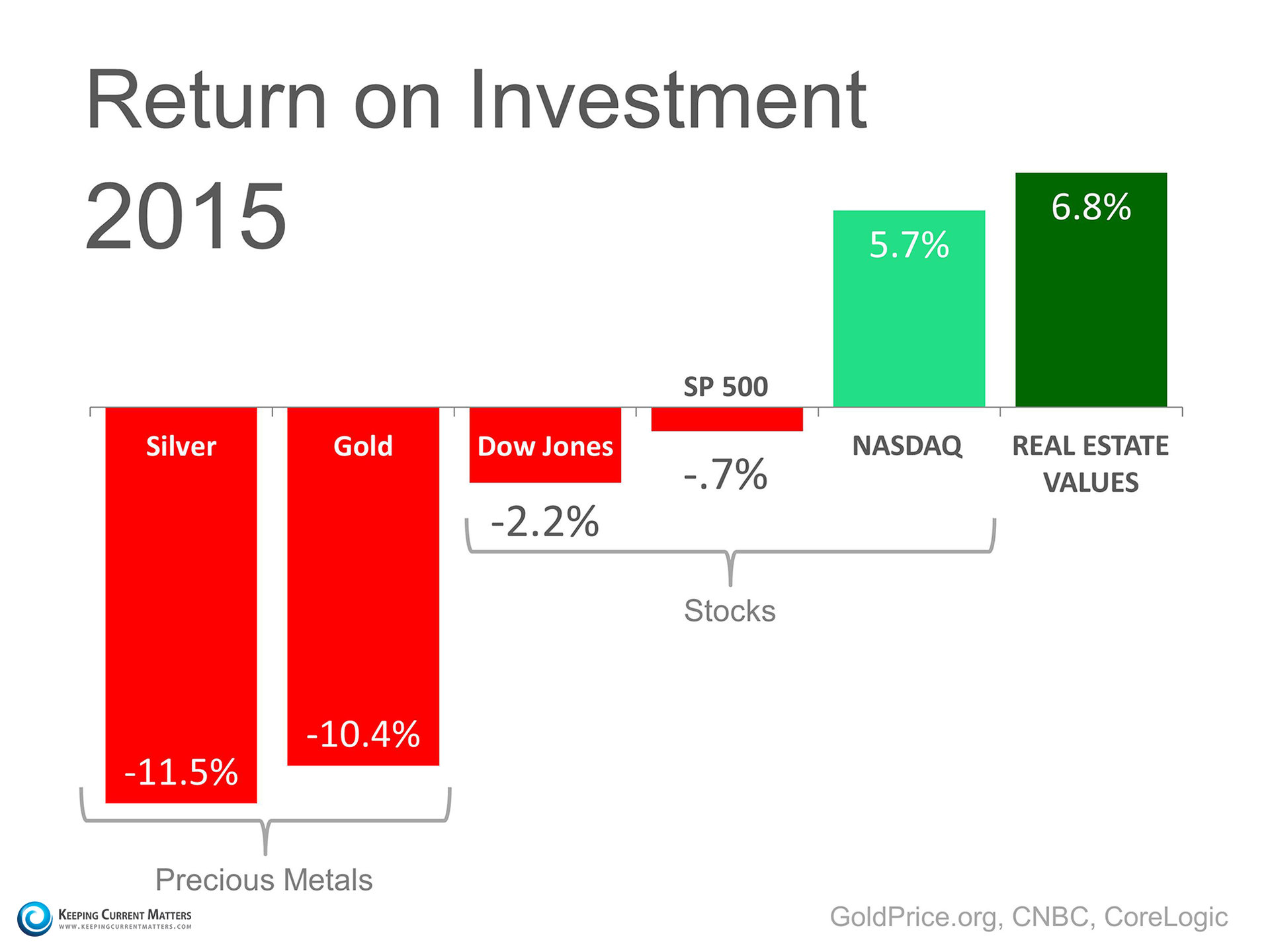
So how did homeownership match up against other investments in 2015? Here is a chart that compares its return on investment against precious metals and the stock market last year:
2015 Return on Investment | Keeping Current Matters

Bottom Line

Not only did homeownership offer all its social benefits. It also was a great investment financially.

Wednesday, December 2, 2015

Real Estate Investments: Are they right for YOU?

Are high yield real estate investments right for you to include in an investment portfolio? To answer the question, the prospective investor must consider the type of real estate investment and the possible risks.

Real estate investments are trusts that purchase and improve properties for the sole purpose of investing. Examples of properties and similar assets are apartments, buildings, mortgages, resorts, and shopping malls. There are ways to determine if a real estate investment is right for you.


Determine if the Broker or Financial Advisor is Registered
Before you select a real estate investment, ensure the broker or financial advisor is registered with Security Exchange Commission (SEC). Brokers and financial advisors should provide the prospective investor with information concerning real estate investments and the risks involved. If the issuer is not registered with SEC, there is a possibility the broker or financial advisor are running scams.

Types of Real Estate Investments
There are two types of real estate investments, public-traded and non-exchange traded. The difference between the two is public-traded investments are traded publicly and non-exchange investments are not traded publicly.

Public-Traded Real Estate Investment Risks
Most investments options come with risks, including public-traded real estate. There are two possible risks involved with public-traded real estate investments. The first risk is when the interest rate is high. According to some economists, public-traded real estate investments don’t perform to its potential when interest rates are increased. Another risk is selecting the wrong real estate investment.

Non-Exchange Real Estate Investment Risk
The biggest risk of non-exchange real estate investment is deficiency of liquidity. When there is a deficiency of liquidity the investor cannot sell shares. Other risks are inability to determine the value of a share and to monitor the value.

Ways to Purchase and Sell Real Estate Investments
Prospective investors can find a list of publicly traded real estate investments on a stock exchange. Shares can be purchased through a licensed broker or financial advisor. If you have an interest in non-exchange investments, select a reputable broker who specializes in non-exchange real estate investment options. There are several options of publicly traded real estate investments, such as, preferred stock, debt security and common stock. The Jakob Pek Fund is an example of a real estate investment company that manages invested capital for limited partnerships and mortgages.

Both non-exchange and public-traded real estate investments offer high returns on invested capital. You can determine if a real estate investment is right for you by performing research on both options before initially investing. The downside of non-exchange options is prospective investors are unable to do research until the offer closes. If the broker or financial advisor is registered with SEC, you are probably selecting the right high yield real estate investment.

About the author: Brooke Chaplan is a freelance writer and blogger. She lives and works out of her home in Los Lunas, New Mexico. She loves the outdoors and spends most her time hiking, biking and gardening. For more information on high yield real estate investments, talk to the Jakob Pek Fund, a leading real estate investment company that manages invested capital for limited partnerships and mortgages.

Wednesday, September 30, 2015

10% down investment property

Looking to invest in real estate?

I can offer 10% down investment property,  no PMI, on non-owner occupied investment properties.
2-4 units.

Fannie mae guidelines require 25% down payment. I can offer much better options.  Look at it this way... for the same investment an investor can purchase two properties!

Contact me today!

Thursday, June 25, 2015

222 S. Main St.-Reeseville, WI 53579


222 S. Main St.-Reeseville, WI 53579

Amber Castonguay
Direct: 920-988-0048
Text: 920-988-0048
Fax: 866-211-2826

RE/MAX Realty Center
357 W Wisconsin Ave
Oconomowoc, WI 53066
Office: 262-567-2455

If you have Family, Friends or Neighbors that are struggling with their mortgage there are options! Contact Amber Castonguay, your local CDPE & SHORT SALE EXPERT to see what your options are!